
 English
 French
 Spanish
 Russian
 Arabic
 Italy
Italy
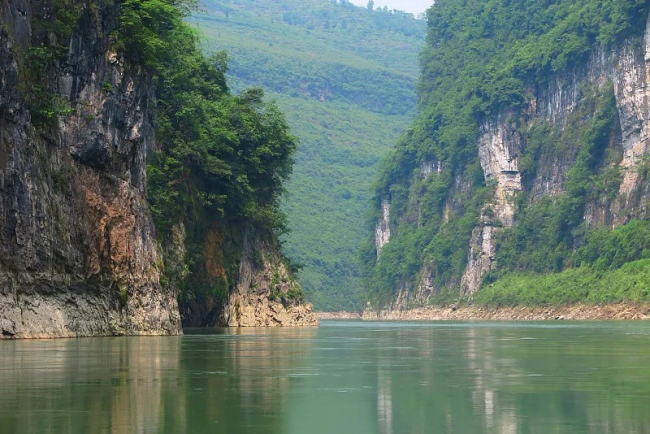
Tongren
Guizhou Province, China · Tongren
“Buddhist Pure Land · Peach-Blossom Tongren”
Contents
I. City Overview
II. Geography & Ecology
III. History
IV. Top Attractions
V. Cultural Heritage
VI. Ethnic Culture & Folk Customs
VII. Local Cuisine
VIII. Crafts & Specialties
IX. Getting There
X. Best Season & Itineraries
XI. Economy
I. City Overview
Tongren lies in northeastern Guizhou, deep in the Wuling Mountains, at the junction of Guizhou, Hunan, and Chongqing—Guizhou's 'eastern gateway.' Named after Mount Fanjing—'Buddhist Pure Land, Peach-Blossom Tongren'—the city is home to one of China's five sacred Buddhist mountains and the bodhimanda of Maitreya, inscribed as a UNESCO World Natural Heritage site in 2018. Covering about 18,000 km² with a population of roughly 3.3 million, Tongren is inhabited by the Dong, Miao, Tujia, Han, and other peoples, with forest coverage above 66%—exceptionally green and ecologically pristine.
Quick Facts
Location | Eastern Guizhou, junction with Hunan & Chongqing (Wuling Mts.) |
Divisions | 2 districts, 4 counties, 4 autonomous counties |
Area | ~18,000 km² |
Population | ~3.3 million |
Ethnic groups | Han, Dong, Miao, Tujia |
Highest peak | Mount Fanjing 2,572 m |
Climate | Mid-subtropical humid monsoon |
II. Geography & Ecology
Tongren lies in northeastern Guizhou, deep in the Wuling Mountains, at the junction of Guizhou, Hunan, and Chongqing—Guizhou's 'eastern gateway.' Mount Fanjing, the main peak of the Wuling range, rises to 2,572 m, among the highest in Guizhou. The Jinjiang, Wujiang, and Yuanjiang river systems originate or flow through here, with mountains and waters interlaced. Tongren has a mid-subtropical humid climate, an annual mean temperature around 16°C, and forest coverage above 66%—over 95% within the Fanjingshan reserve—truly a 'natural oxygen bar' and 'gene bank of flora and fauna.'
III. History
Tongren was established as a prefecture in 1413 (11th year of Yongle, Ming). Legend says a 'bronze-figure' boulder at the confluence of two rivers outside the city gave it the name 'Tongren' (bronze person). It then became the political, military, and cultural center of eastern Guizhou. By the mid-Ming, Miao and Tujia ancestors thrived here; Tongren was also a key node on the ancient 'Qianzhong Trail' and the 'Miao Frontier Corridor,' a crossroads of commerce and strategy. In modern times, the Red 2nd and 6th Corps joined forces here to build the East Guizhou Revolutionary Base, and revolutionaries such as Zhou Yiqun and Kuang Jixun emerged from this land.
IV. Top Attractions
Mushroom Rock, Mount Fanjing
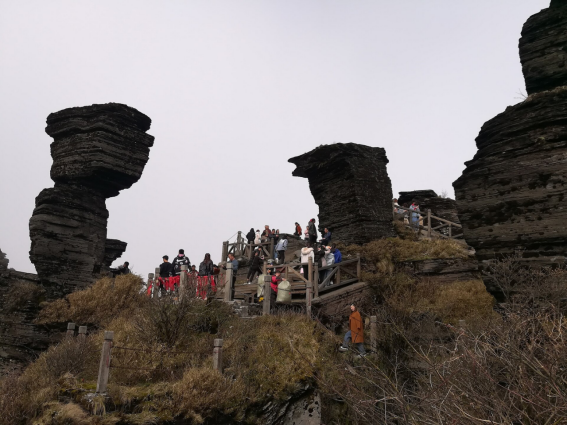
Mushroom Rock, Mount Fanjing
Mount Fanjing straddles Jiangkou, Yinjiang, and Songtao counties, the main peak of the Wuling Mountains at 2,572 m, inscribed as World Natural Heritage in 2018. Mushroom Rock is its most iconic sight—a massive boulder weathered over 1.4 billion years into a mushroom shape that seems to defy gravity. Fanjingshan is also the only home of the Guizhou snub-nosed monkey and the Fanjing fir, with extraordinary biodiversity, and is a UNESCO Man and the Biosphere reserve.
Red Cloud Golden Summit
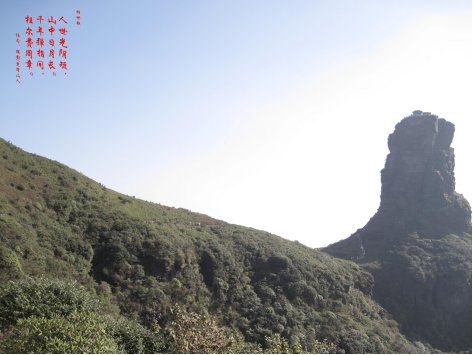
Red Cloud Golden Summit
The Red Cloud Golden Summit, at 2,336 m, is Fanjingshan's second highest peak, named for the red clouds that often surround it at sunrise. A great natural cleft splits the summit into two pinnacles linked by a stone bridge; temples to Śākyamuni and Maitreya stand on either side, symbolizing the guidance from 'present' to 'future.' Known as the 'Castle in the Sky' and 'Buddhist Pure Land,' it is a sacred destination for pilgrims and visitors alike.
Jinjiang Night View & Zhongnanmen Old Town
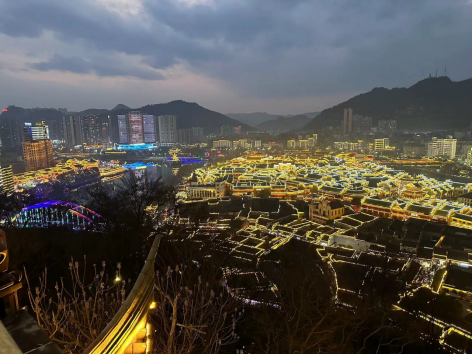
Jinjiang Night View & Zhongnanmen Old Town
The Jinjiang River is Tongren's mother river, flowing through the city center where ancient towers and modern bridges meet. At night the lights shimmer on the water, and the Zhongnanmen Historical and Cultural District is the best-preserved Ming–Qing old town in Tongren—blue-stone lanes, fireproof gable walls, and courtyards recalling its past as the 'eastern-Guizhou trading port.' Blending intangible-heritage experiences, local dining, and guesthouses, it is the best place to feel Tongren's slow-paced life.
Tongren City View
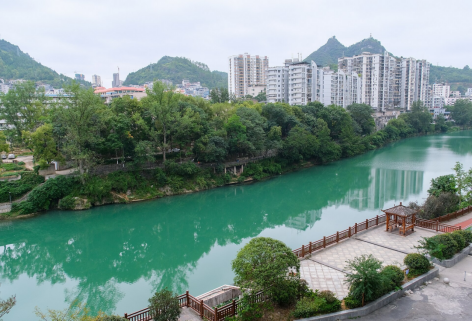
Tongren City View
Tongren's urban center nestles between mountains and water, with the Jinjiang River winding through green hills. As Guizhou's eastern gateway, it combines a modern city atmosphere with historic and natural sites such as Zhongnanmen Old Town, Dongshan Temple, and Sanjiang Park. From above, the city merges with the Wuling landscape, presenting a distinctive mountain-water cityscape where 'hills sit within the city, and the city within the green.'
V. Cultural Heritage
Tongren's most dazzling world heritage is Mount Fanjing—inscribed on the UNESCO World Heritage List in 2018—one of China's five sacred Buddhist mountains and the bodhimanda of Maitreya. The Cheng'en Temple, Huguo Temple, and ancient summit temple complex have burned incense for a millennium. Tongren also preserves the Zhongnanmen Historical District, Miao King City, the Shiqian Wanshou Palace and hot-spring architectural complex, the Zhaiying Rolling Dragon (national intangible heritage), and the Dejiang Nuo-tang opera—'a living fossil of Chinese theatre'—together painting a diverse picture from Buddhist holy mountain to frontier trading town.
VI. Ethnic Culture & Folk Customs
Tongren is a home where the Dong, Miao, Tujia, Han, and others thrive together. The Dong Grand Song is world-renowned: its multi-part, conductor-less, unaccompanied choral singing is called 'music of the heavens' and was inscribed on the UNESCO Representative List of Intangible Cultural Heritage in 2009. Miao silverwork is exquisite and Miao embroidery vibrantly colored; Tujia hand-waving dance and weeding gongs are rustic and joyful; even the Qiang (in Sinan) leave unique marks. The festivals, songs, and crafts of these peoples paint Tongren's colorful cultural scroll.
VII. Local Cuisine
Dish | Description |
Tongren She Fan | Glutinous rice steamed with wild herbs, cured pork, and scallions—fragrant and sticky, a traditional Dong and Miao dish made each spring festival. |
Jiangkou Mung Bean Noodles | Thin, silky noodles made from mung bean and rice batter, served boiled or stir-fried—a hometown taste of Jiangkou. |
Miao Sour Soup Fish | Fresh fish poached in a sour broth fermented from tomatoes and rice soup—mildly sour, spicy, appetizing, a Miao hospitality staple. |
Tongren Rice Tofu | Rice batter cooked and cooled, cubed and tossed with chili, scallions, and fishwort—cool, silky, a summer snack. |
Sinan Flower-Sweet Cake | A Sinan specialty of glutinous rice and barley malt, sliced to reveal flower patterns—sweet but not cloying, symbolizing reunion. |
VIII. Crafts & Specialties
Tongren's produce and crafts are distinctive. High-mountain mist teas such as Fanjingshan tea, Shiqian moss tea, and Yinjiang green tea are fragrant and sweet—a major Guizhou tea region. The Yuping xiao (vertical flute) and di (transverse flute), one of 'Guizhou's three treasures,' are national intangible heritage, with pure tone and exquisite carving. Other fine gifts include Songtao Miao embroidery, Miao silverwork, Sinan flower-sweet cake, Shiqian preserved eggs, and Yanhe goat.
IX. Getting There
Transport: Tongren Fenghuang Airport, Tongren Railway Station, and the Tongren South Station on the Shanghai–Kunming high-speed railway connect the city to the rest of the province and country; the Tongren–Yuping intercity railway is also in service. It is about 1.5 hours by high-speed train from Guiyang to Tongren South, then about 1 hour by shuttle to Fanjingshan.
X. Best Season & Itineraries
Best time to visit: Spring (April–May) brings alpine azaleas; summer (June–August) is cool and ideal for escaping the heat; autumn (September–November) offers crisp air and the best sea-of-clouds sunrises. Winter snowscapes and rime are beautiful, though the summit is cold—keep warm and watch for visitor caps.
Recommended itineraries:
· Fanjingshan Pilgrimage One-Day: ascent from Heiwan River (Jiangkou) — Red Cloud Golden Summit — Mushroom Rock — Shiqian hot spring on return.
· Ancient Town & Folkways Two-Day: Zhongnanmen Historical District — Jinjiang night cruise — Miao King City — Songtao Miao embroidery experience.
· Eco-Wellness Three-Day: Fanjingshan — Yamugou — Jiulong Cave — Shiqian ancient hot-spring cluster — Sinan Wujiang Hundred-Li Gallery.
XI. Economy
Tongren is Guizhou's bridgehead opening eastward. Riding on the world-class ecological brand of Fanjingshan, eco-tourism, wellness retreats, and cultural tourism are booming. In agriculture it is a key base for tea, Chinese medicinal herbs, oil-tea camellia, and livestock, with the public brand 'Fanjingshan Treasures · Healthy Living' gaining prominence. Industrially, manganese-based new materials, new building materials, and energy are growing steadily; the Wanshan cinnabar (mercury) mine was once 'China's mercury capital.' In 2023 regional GDP was about 150 billion yuan, and Tongren is accelerating its pilot as an inland open-economy zone.