
 English
 French
 Spanish
 Russian
 Arabic
 Italy
Italy
Anshun
Guizhou Province, China · Anshun
“Waterfall Homeland · Living Ming Heritage · Home of Batik”
Contents
I. City Overview
II. Geography & Ecology
III. History
IV. Top Attractions
V. Cultural Heritage
VI. Ethnic Culture & Folk Customs
VII. Local Cuisine
VIII. Crafts & Specialties
IX. Getting There
X. Best Season & Itineraries
XI. Economy
I. City Overview
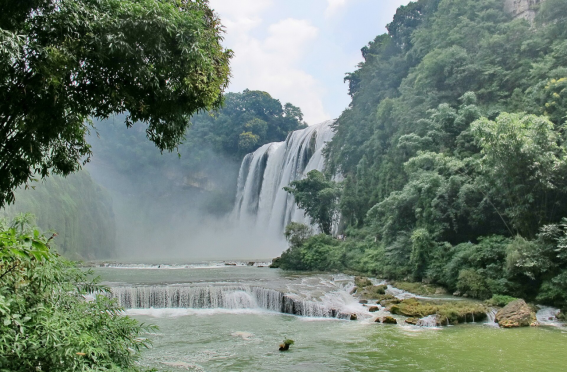
Located in west-central Guizhou (the heart of the central Guizhou plateau), about 90 km from Guiyang, Anshun is a key transport hub and tourist destination. Known as 'China's Waterfall Homeland,' it is home to Huangguoshu Waterfall, the largest in Asia. Anshun is also the cradle of Tunpu culture, where descendants of Ming-dynasty garrisons preserve unique dialects, dress, and stone architecture—earning it the name 'a living fossil of Ming history.' The prefecture covers about 9,269 km² with a population of roughly 2.45 million, and the Buyi and Miao peoples make up nearly 40% of the total.
Quick Facts
Location | West-central Guizhou (central plateau) |
Divisions | 2 districts, 1 county, 3 autonomous counties |
Area | ~9,269 km² |
Population | ~2.45 million |
Ethnic groups | Han, Buyi, Miao |
Avg. elevation | ~1,200 m |
Climate | Humid subtropical monsoon |
II. Geography & Ecology
Anshun sits in the central Guizhou Plateau, in the western Miao Mountains, and is a classic concentration of karst landforms—peak forests, caves, gorges, waterfalls, and underground rivers all fully developed, earning it the names 'China's Waterfall Homeland' and 'Karst Kingdom.' Its elevation mostly ranges from 1,000 to 1,400 m, within the Beipanjiang basin of the Pearl River system. The climate is mild and humid, with an annual mean temperature around 14°C and over eight comfortable months a year—an ideal summer retreat. Forest coverage is about 60%, and scenic areas like Huangguoshu and Dragon Palace have extremely high negative-oxygen-ion levels, a 'natural air conditioner.'
III. History
Anshun has a long administrative history: it belonged to the Zangke Kingdom in the Spring and Autumn period, became Puding Prefecture in the Yuan dynasty, and in 1382 (15th year of Hongwu, Ming) the city was walled and Anshun Prefecture established, its name meaning 'peace and smooth progress.' Early-Ming military migrations—'Sending the North to Conquer the South' and 'Filling the South from the North'—brought hundreds of thousands of garrison families from the Jianghuai and Central Plains to settle and farm the frontier, creating the distinctive Tunpu settlements. For over 600 years the Tunpu people have preserved Ming-dynasty Jianghuai dress, dialect, and customs, making Anshun a 'living fossil of Ming history.'
IV. Top Attractions
Huangguoshu Waterfall
Huangguoshu Waterfall
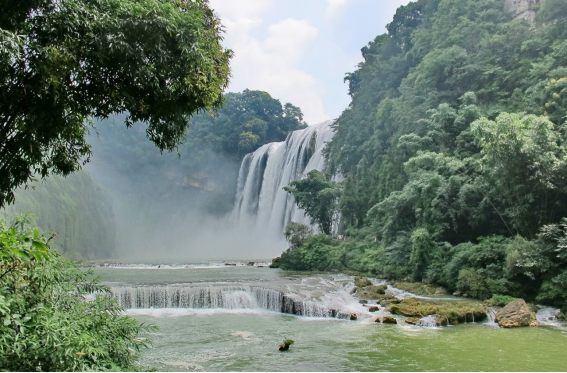
Huangguoshu Waterfall on the Baishui River in Zhenning County drops 77.8 m and spans 101 m, making it China's largest and one of the world's great waterfalls. Its thunderous roar and drifting mist often reveal rainbows in the sunlight—a spectacular sight. The scenic area comprises three sections—the Great Waterfall, Doupotang, and Tianxingqiao—combining falls, caves, stone forests, and gorges. It is among China's first national 5A attractions and a filming location for 'Journey to the West' and other productions.
Dragon Palace
Dragon Palace
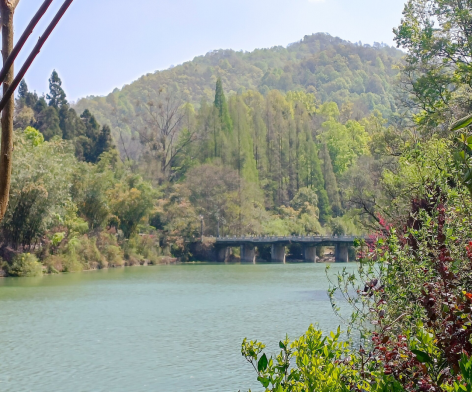
Dragon Palace lies on the southern outskirts of Anshun, a karst wonder combining caves, canyons, waterfalls, peak forests, cliffs, streams, and stone forests, featuring China's longest and most beautiful water cave. A boat ride through the cavern reveals fantastical stalactites and winding underground rivers, earning it the name 'Underground Li River'; the Dragon Gate Falls plunge from a skylight with great force. Together with Xuantang and the Rapeseed Lake, it forms a national scenic area—perfect for exploring the karst underworld.
Tianlong Tunpu
Tianlong Tunpu
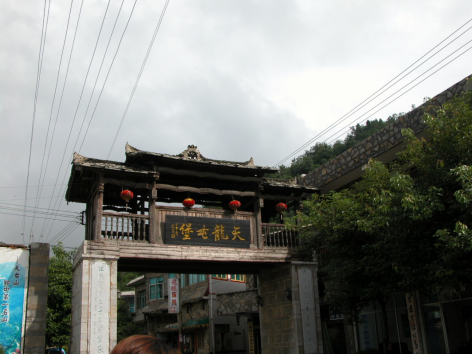
Tianlong Tunpu, in Pingba District, is a settlement of descendants of Ming-dynasty garrisons sent to pacify the southwest, preserved for over 600 years. Its stone-walled, stone-tiled Ming houses survive intact; women in 'Fengyang Han dress,' the rustic and heroic Dixi (military nuo) opera, and the 18th-day 'Carrying Lord Wang' rite make visitors feel transported to the Ming. Tunpu culture is a rare living example of a Han subculture perpetuated in the southwest and was named a 'Famous Historical and Cultural Town of China' in 2019.
Tianxingqiao & Getu River
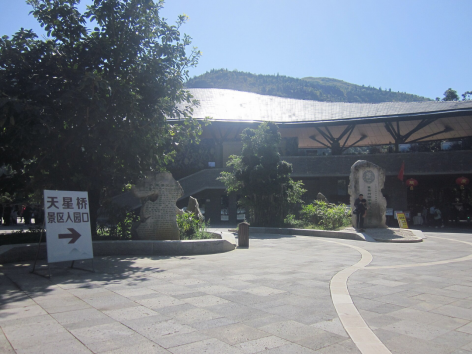
Tianxingqiao & Getu River
Tianxingqiao is one of the three main sections of the Huangguoshu Scenic Area, famous for its water stone forests, caves, natural bridges, and the Silver-Chain-Plunge Pool Waterfall. Rocks, trees, and water intertwine along trails that reveal a new view at every step, praised as 'a garden of ten thousand bonsai, an eternal painting.' In Ziyun County, the Getu River is renowned for its 'cave-piercing' wonder—the great river flows straight through a giant karst cave—and the cliffside 'Spider Men' who free-climb its walls make it a mecca for international rock climbers.
V. Cultural Heritage
Anshun's cultural heritage is brilliant. The Huangguoshu Waterfall cluster was among China's first national scenic areas, and both Huangguoshu and Dragon Palace are national 5A attractions. The Tunpu 'Anshun Dixi' (military nuo opera) was listed in the first batch of national intangible cultural heritage in 2006; its carved wooden masks (lianzi) are exaggerated and vividly colored. Anshun batik, with its long lineage, is hailed as 'the Orient's No.1 dye.' The Guanling Yongning gazetteer, the Puding Chuandong Paleolithic site, and the Pingba Feihu Mountain site trace Anshun's civilization from prehistory to the Ming and Qing.
VI. Ethnic Culture & Folk Customs
Anshun is a harmonious home to many peoples; the Buyi and Miao together make up nearly 40% of the population. The Buyi live by the water, singing mountain songs, pounding glutinous rice, and dancing the bamboo-pole dance at festivals. The hospitable Miao celebrate the Miao New Year, Flower-Jumping slopes, and lusheng fairs with silver ornaments and embroidery of exquisite craft. The Tunpu, as descendants of Ming garrisons, add a time-traveling depth with their Dixi opera, stone villages, Fengyang Han dress, and 'Carrying Lord Wang' rite, making Anshun a living specimen for ethnology and anthropology.
VII. Local Cuisine
Dish | Description |
Anshun Guo Juan | Thin rice paper rolls stuffed with bean sprouts, pickled radish, kelp, and a secret chili sauce—sour, spicy, appetizing street food. |
Zhenning Bo Bo Candy | A century-old traditional sweet, crisp and fragrant, melt-in-the-mouth—once a tribute and Anshun's signature specialty. |
Duoduo Rice Noodles | Anshun-style hot-pot rice noodles with rice tofu, minced pork, and sour broth—numbing, spicy, and comforting. |
Anshun Crispy Bao | Flaky, layered steamed buns with a savory pork-and-bamboo-shoot filling—a local breakfast favorite. |
Guanjiang Dog Meat | A famous dish of Guanjiang Town, Guanling—stewed tender and served with a spicy dipping sauce (a local specialty, by personal preference). |
VIII. Crafts & Specialties
Anshun is world-famous for batik and is called 'the home of batik.' Anshun batik uses mainly blue and white, with patterns drawn from nature and totems—rustic and elegant—and is exported worldwide. The 'Anshun Three Knives' (kitchen, scissors, and leather knives) are sharp and durable traditional products. Other fine gifts include Zhenning Liuma honey plums, Ziyun red-heart sweet potato, Guanling dragon fruit, Huangguoshu Waterfall Liquor, and Anjiu baijiu.
IX. Getting There
Transport: Anshun Huangguoshu Airport links to several domestic cities. The Shanghai–Kunming high-speed railway, conventional railway, and expressway pass through the prefecture. From Guiyang Longdongbao Airport it is about 30 minutes by high-speed train to Anshun West Station, then about 40 minutes by shuttle to Huangguoshu Scenic Area.
X. Best Season & Itineraries
Best time to visit: Huangguoshu is most impressive from June to October during the rainy season, when water volume peaks. Spring and autumn are mild and ideal for exploring Tunpu villages, caves, and gorges, and are also flower seasons.
Recommended itineraries:
· Waterfall Wonders One-Day: Huangguoshu Great Waterfall — Tianxingqiao — Doupotang.
· Karst Caves Two-Day: Dragon Palace — Getu River (Cave, Spider-Man climbing) — Ziyun.
· Tunpu Culture Two-Day: Tianlong Tunpu — Yunfeng Eight Villages — Jiuzhou ancient town (taste local snacks).
XI. Economy
Anshun is a key tourist city and aviation-industry base in Guizhou. Riding on world-class attractions like Huangguoshu and Dragon Palace, tourism is a pillar industry, receiving tens of millions of visitors a year. Industrially, Anshun is an important Chinese aviation base (the former 'Third Front' 011 base), home to aerospace firms such as Guifei; it also develops specialty light industry, new building materials, and green agriculture. In 2023 regional GDP was about 110 billion yuan, and Anshun is actively integrating into the 'strong provincial capital' Guiyang metropolitan circle.